HDHMR vs Plywood: Where It Beats Plywood, and Where It Fails
HDHMR is usually sold as an upgrade — denser than MDF, more moisture-resistant, smoother than plywood. All three are true. What the pitch leaves out is that a fibreboard, however dense, holds a screw and carries a load differently from cross-laminated wood, and that difference decides where it belongs.
AlcorOne Solutions is an execution-first interior contracting firm delivering turnkey residential and commercial fit-outs across South India. It is headquartered in Chennai, with offices in Hyderabad, Visakhapatnam and Rajamahendravaram. All work is manufactured in-house and assembled on site — no subcontracting, no surprise substitutions mid-project.
What HDHMR is
HDHMR stands for High Density High Moisture Resistance. It is a fibreboard: wood fibres bonded with a moisture-resistant synthetic resin and pressed at a higher pressure and temperature than ordinary MDF. The result is a heavy, uniform board — typically above 850 kg/m³, against 600–700 kg/m³ for standard MDF — with a smooth, grain-free face.
Plywood is a different kind of material altogether. Thin wood veneers are laid with their grain at right angles and bonded under pressure. BWP plywood to IS 710 uses a boiling-water-proof bond; BWR and MR grades to IS 303 are for drier positions. The alternating grain is what gives plywood its stiffness and its grip on a screw thread.
That difference — fibres pressed into a block versus wood layers crossed against each other — explains nearly everything in the comparison below.
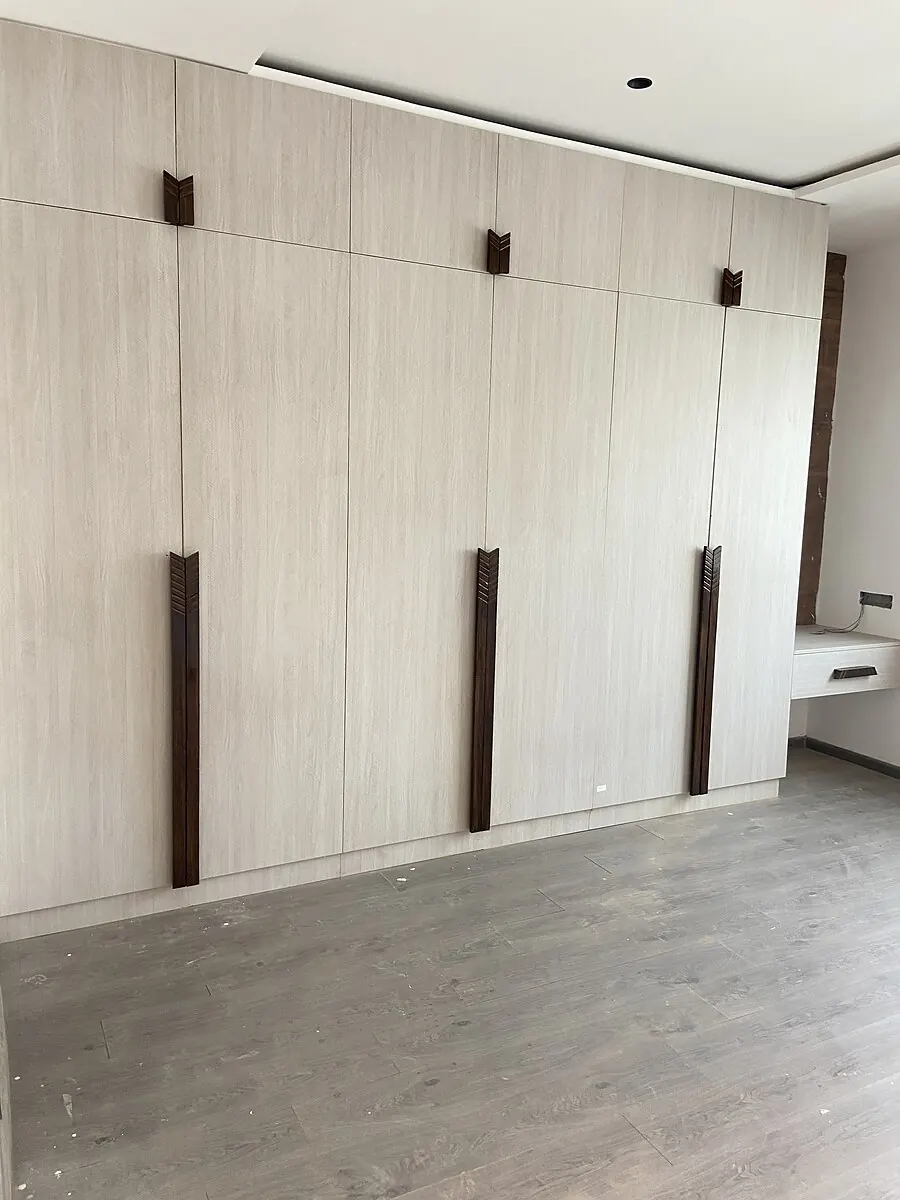
HDMR or HDHMR: is there a difference?
You will see both names. They describe the same family of high-density, moisture-resistant fibreboard, and different manufacturers use different names and acronyms for their versions. The name tells you less than the product data does. Compare boards on their stated density, their moisture and swelling performance, and the brand and product name written into your BOQ — not on whether the label has one H or two.
The comparison that matters
| Property | HDHMR | BWP plywood (IS 710) | Standard MDF |
|---|---|---|---|
| What it is | Dense fibreboard, moisture-resistant resin | Cross-laminated wood veneers, boiling-water-proof bond | Medium-density fibreboard |
| Density | High — typically above 850 kg/m³ | Lower than HDHMR | Medium — 600–700 kg/m³ |
| Humidity and splash | Resists well | Resists well | Swells permanently |
| Standing or pooling water | Not designed for it | The safest of the three | Fails |
| Screw-holding over years of use | Good — far better than MDF | Best of the three | Poor |
| Load across a span | Moderate, and heavy for its size | High | Low |
| Paint and PU finish | Excellent — no grain to telegraph | Grain shows through paint | Good, until moisture reaches it |
| Routing, fluting, CNC | Excellent — clean, sharp edges | Poor — veneer layers chip | Good, edges can fray |
| Termites and borer | Highly resistant | Treated in manufacture; resistant, not immune | Low to moderate |
| Indian Standard to demand | No IS grade to cite — judge by data sheet and brand | IS 710 (BWP) or IS 303 (BWR, MR) | No IS grade to cite here |
Where HDHMR beats plywood
Painted and PU shutters. A high-gloss or matt PU finish shows every irregularity underneath it, and plywood's grain telegraphs through paint. HDHMR's uniform face is why it is the usual substrate for handle-less painted kitchens and painted wardrobe shutters.
Fluted panels, CNC jali and routed profiles. Cutting a groove into plywood exposes its layers, and the veneers chip. HDHMR cuts clean and holds a sharp edge, which is why fluted wall panels and routed shutter designs are almost always made from it.
Large flat wall panelling. A uniform fibreboard stays flat across a large panel, provided the wall behind it is dry.
Against termites. The resin-bonded fibre core gives borers and termites very little to work with.
Material Grades: Choosing the Right Plywood
Selecting the wrong wood grade for a specific area is the primary cause of premature interior failure. Here is the full hierarchy:
| Grade | Standard | Water Resistance | Best Used For |
|---|---|---|---|
| BWP (Marine Ply) | IS 710 | Boiling water — no delamination | Kitchen sink cabinet, utility storage, bathroom vanities, wet-wall units |
| BWR Plywood | IS 303 | High humidity + splashes | Kitchen wall cabinets, dining crockery units, dry overhead storage |
| Commercial / MR | IS 303 (MR) | Humidity only — no direct water | Bedroom wardrobes, TV units, study desks |
| HDHMR | — | High moisture resistance | Wardrobe shutter doors, kitchen shutters (high-gloss / PU finishes) |
| MDF / Particle Board | — | Poor — swells permanently | Low-wear vertical partitions only; avoid in kitchens entirely |
Rule: BWP IS 710 for any unit within 1 metre of a water source. BWR IS 303 for wall cabinets above the splash zone. Commercial MR for all dry rooms.
The disadvantages of HDHMR
This is the part most comparisons leave out, and it is the part that decides the specification.
- It is not for standing water. "High moisture resistance" means humidity, steam and splashes. Under a sink that leaks, or on a floor that is mopped every day, the bottom edge of a fibreboard is exposed to water it was never designed to sit in. BWP plywood is the safer board wherever water can pool.
- It holds a screw well once, and less well the second time. HDHMR grips a screw far better than MDF, but a fibreboard does not re-take a screw the way cross-laminated plywood does. A hinge that is re-fixed, or a screw that is over-driven at installation, has less to bite into on the second attempt.
- It is heavy. A tall HDHMR shutter weighs noticeably more than a plywood one of the same size, and that weight hangs on the hinges. Tall shutters need the hinge count and hinge series chosen for the weight, not for the size alone.
- Its edges must be sealed. The faces resist moisture; a raw cut edge is the weak point. Every exposed edge needs banding or a sealed paint system, and the edge banding specification belongs in the BOQ.
- It is not the board for a loaded carcass. A kitchen base unit carries a stone countertop, a full drawer stack and daily hinge cycles. Plywood's stiffness and screw retention matter more there than a perfect surface that will be hidden behind the shutters anyway.
- There is no IS grade to demand. With plywood you can ask for IS 710 and check the stamp on the board. With HDHMR you rely on the manufacturer's data sheet and the brand, so an unnamed "HDHMR" line in a quote is effectively unspecified.
Where each board belongs
- Kitchen base carcass, sink unit, utility storage — BWP plywood to IS 710. Loaded, screwed, hinged daily, and within reach of water that can pool.
- Kitchen wall-unit carcass — BWR plywood to IS 303. Steam and splash, but no standing water and lighter loads.
- Painted or PU kitchen and wardrobe shutters — HDHMR. The finish needs a grain-free face, and a shutter is not a structural member.
- Fluted panels, routed shutters, CNC jali — HDHMR. Clean machining is the whole point.
- Wardrobe carcass and lofts — plywood. Tall shutters, hanging loads and shelves carrying weight across a span are conditions plywood handles best.
- Large wall panelling on a dry wall — HDHMR. Flat, stable and easy to finish; keep it off a wall with damp behind it.
The combination most homes end up with is a plywood carcass behind HDHMR shutters: plywood where the strength and water exposure are, HDHMR where the finish is. That is not a compromise. It is each board doing the job it is best at.
On cost
Per sheet, HDHMR generally sits above commercial MR plywood and below premium BWP marine plywood, and well above standard MDF — our HDHMR vs MDF comparison publishes the per-square-foot sheet band with its basis. The sheet price is the wrong comparison, though. A carcass that needs its hinges re-seated in year four has not saved anything, and a painted plywood shutter that shows its grain has not either.
What the rates are for your flat belongs in a line-item quotation against a named board, not in an article — see the cost per square foot guide for how the bands are built.
How to write it into a BOQ
The single most useful thing you can do is make the quotation name the board per component rather than per job. "Kitchen in HDHMR" or "wardrobes in plywood" is not a specification. A usable line reads like this:
- Carcass: 18mm BWP plywood to IS 710, brand named.
- Shutters: HDHMR, thickness, brand and product name, density from the data sheet.
- Edges: banding thickness on exposed edges and on internals, stated separately.
- Finish: PU system and number of coats, or laminate brand and shade code.
- Hinges: brand and series, with the count per shutter chosen for the shutter weight.
The free modular kitchen BOQ and wardrobe BOQ templates both separate the carcass grade from the shutter substrate for exactly this reason.
The honest limit of the comparison
Neither board is simply better. HDHMR in a painted shutter is a good engineering decision; the same board as a sink-unit carcass is a poor one, and it is the same board. Anyone who recommends one material for the whole job is usually recommending the one they stock.
The other caveat is quality spread. "HDHMR" is a category, not a grade, and density varies between manufacturers. Ask for the data sheet, put the brand and product name in the BOQ, and treat an unnamed board as unspecified.
Written by Gogineni Kalyaan Kumar
Kalyaan is Principal at AlcorOne Solutions, the interior contracting firm he co-founded in 2022. He has overseen 80+ turnkey residential, villa, and commercial fit-outs across Chennai, Hyderabad, Bengaluru and Vizag, with a focus on itemised BOQs, heavy-duty modular execution, and durable interior systems built for South India’s climate.
Sources & references.
Standards, regulatory registries, and manufacturer references that back the material grades, pricing framework, and compliance points in this guide:
Frequently asked questions.
What is the full form of HDHMR?
HDHMR stands for High Density High Moisture Resistance. It is a fibreboard made from wood fibres bonded with a moisture-resistant synthetic resin and pressed at high pressure and temperature, giving a heavy, uniform board — typically above 850 kg/m³ — with a smooth, grain-free face.
Is HDHMR better than plywood?
For some jobs. HDHMR is better for painted and PU shutters, fluted and CNC-routed panels and large flat panelling, because its face has no grain and it machines cleanly. Plywood is better for carcasses, loaded shelves and anywhere water can pool, because it holds screws better over years of use and BWP grade to IS 710 tolerates standing water. Most kitchens and wardrobes use a plywood carcass with HDHMR shutters.
What are the disadvantages of HDHMR?
It is not designed for standing water, it does not re-take a screw as well as plywood once a fixing has been disturbed, it is heavy so tall shutters need hinges chosen for the weight, its cut edges must be sealed, and there is no IS grade to demand — you rely on the manufacturer's data sheet and brand.
Is HDHMR waterproof?
It is moisture-resistant, not waterproof. It handles humidity, steam and splashes well, which is why it suits kitchen shutters. It is not meant to sit in pooling water, so under-sink carcasses and units on a mopped floor are better in BWP plywood to IS 710.
Can HDHMR be used for a kitchen carcass?
It can be, but it is not the board we would choose. A base carcass carries a stone countertop, drawer stacks and daily hinge cycles, and sits within reach of leaks. BWP plywood's screw retention and water tolerance matter more there than a perfect surface hidden behind the shutters. Use HDHMR for the shutters instead.
How are AlcorOne projects paid for?
Projects require an upfront deposit of 20% of the total contract value before work begins, adjusted against the final invoice. The remaining payment is released in milestones tied to project progress — material procurement, civil and carpentry completion, finishing and handover — and the exact milestone schedule is agreed in writing for each project, since it varies with project size, scope and site conditions. Anything not listed in the signed BOQ is out of scope until it is agreed in writing as a variation, costed and confirmed before execution. Published rates are exclusive of GST.
What warranty does AlcorOne give on its interior work?
Three tiers, stated separately because they cover different things and expire at different times. Ten years on the plywood carcass from the date of handover, against delamination, borer attack and manufacturing defect in the board — conditional on the grade specified in the signed BOQ being the grade supplied and installed. One year on installation and workmanship: alignment, levelling, fixing, edge-banding and similar. Hardware, fittings and appliances carry the manufacturer's own term, and AlcorOne registers that documentation in the client's name at handover and facilitates the claim. Not covered under any tier: water ingress originating from base-building or plumbing defects outside AlcorOne's scope; damage from misuse, unauthorised modification, or third-party work carried out after handover; and normal wear to finishes.
The right answer is almost never one board for the whole job. It is plywood where the load and the water are, and HDHMR where the finish is — each one named in the quotation against the component it is used for.
AlcorOne specifies the board per component in the BOQ — carcass, shutter, panel — so the material under your finish is a decision you approved rather than whatever the workshop had in stock.
Want each board named where it is used?
We specify the board per component in the BOQ — carcass, shutter, panel — rather than one board for the whole job.
Get a callback + itemised BOQ
Leave your name and number — we'll call you back with a scope and a ballpark BOQ for your Hyderabad project. No obligation.