Wardrobe Cost Per Running Foot: How to Convert It, and Why It Hides the Height
A carpenter quotes ₹9,000 per running foot. A published guide says ₹1,200 per square foot. One sounds seven times the other. They can be the identical price — and the only way to know is to ask a question neither number contains.
AlcorOne Solutions is an execution-first interior contracting firm delivering turnkey residential and commercial fit-outs across South India. It is headquartered in Chennai, with offices in Hyderabad, Visakhapatnam and Rajamahendravaram. All work is manufactured in-house and assembled on site — no subcontracting, no surprise substitutions mid-project.
What each unit actually measures
A running foot (also written rft, or "linear foot") measures one dimension: the width of the wardrobe along the wall. A 8-foot-wide wardrobe is 8 running feet, whether it stops at 7 feet high or runs to the slab.
A square foot, in wardrobe pricing, measures the elevation — width multiplied by height. This is the convention behind the rates published on this site: a 6 ft × 7 ft wardrobe is quoted as 42 sq ft, and a 8 ft × 9 ft master-bedroom wardrobe as 72 sq ft.
Note what that means. Square-foot pricing is not floor area and it is not surface area of every panel. It is the flat rectangle the wardrobe presents to the room. Both units describe the same cabinet. Only one of them contains the height.
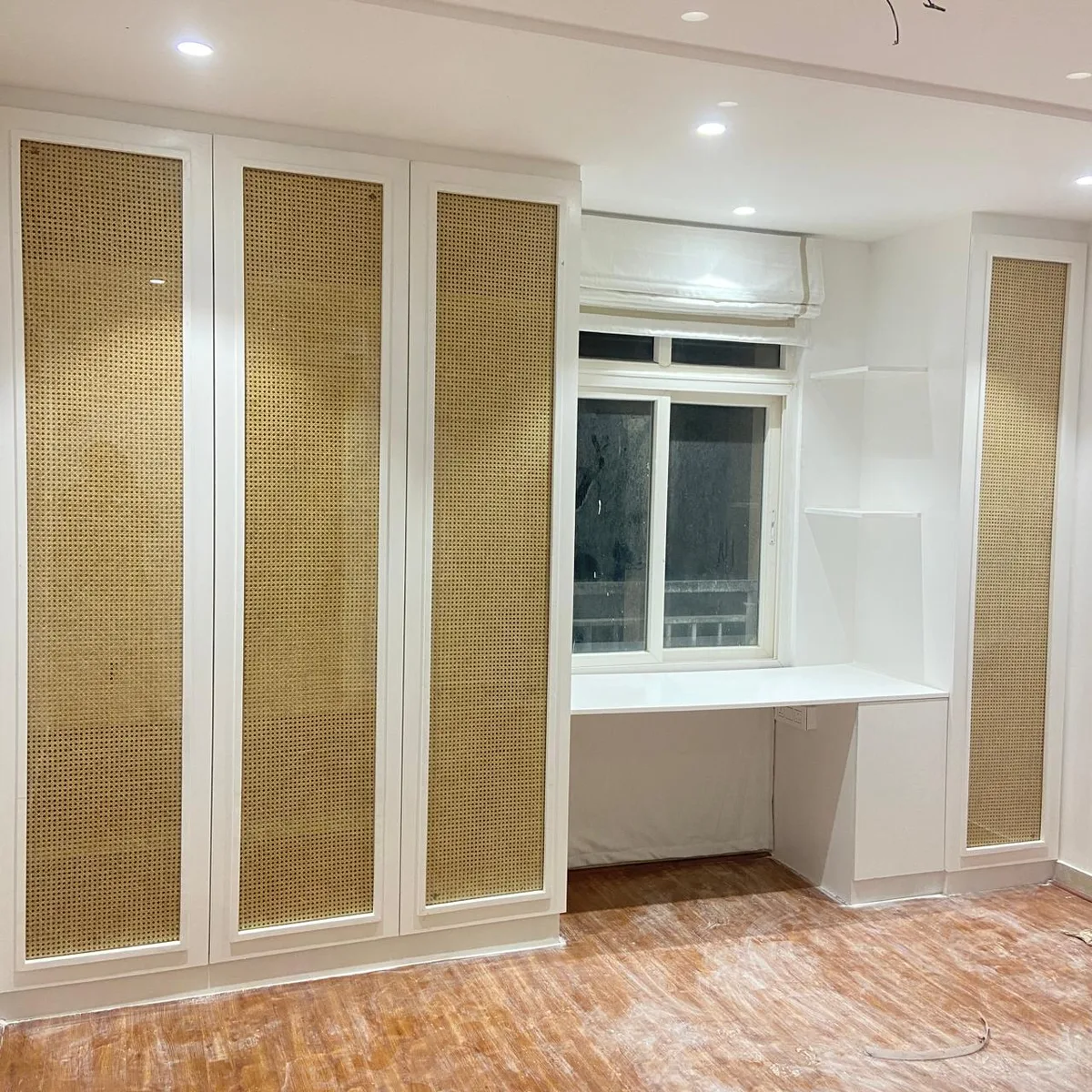
The conversion, with published numbers
The arithmetic is one line:
Rate per running foot = rate per square foot × height in feet
Using the rates published in our Hyderabad wardrobe cost guide — ₹1,200–1,500 per sq ft for hinged, and ₹1,500–1,950 per sq ft for sliding, which carries a 20–30% premium for tracks and rollers:
| Wardrobe height | Hinged, at ₹1,200/sq ft | Hinged, at ₹1,500/sq ft | Sliding, at ₹1,950/sq ft |
|---|---|---|---|
| 7 ft (no loft) | ₹8,400 per rft | ₹10,500 per rft | ₹13,650 per rft |
| 8 ft | ₹9,600 per rft | ₹12,000 per rft | ₹15,600 per rft |
| 9 ft (to slab, with loft) | ₹10,800 per rft | ₹13,500 per rft | ₹17,550 per rft |
No new rate is being introduced here. Every figure in that table is one of the two published square-foot bands multiplied by a height. The point of the table is that the same wardrobe, at the same rate, spans ₹8,400 to ₹17,550 per running foot depending only on height and shutter type. A running-foot number quoted without both of those is not a price. It is a fragment of one.
Three ways the unit conceals scope
Because the running-foot rate absorbs height silently, it absorbs other things too.
1. The loft is quoted separately, or not at all
A 7-foot wardrobe and a 9-foot wardrobe occupy the same running feet. The second one contains roughly two extra feet of full-width storage. If one quote is for 7 feet and the other to the slab, the cheaper running-foot rate may be the more expensive wardrobe per unit of storage — or the loft may reappear later as an extra. Ask whether the quoted rate runs to the slab.
2. Depth disappears entirely
Neither unit contains depth. This matters more for sliding wardrobes than most buyers realise: the track mechanism occupies three to four inches, so the outer frame has to be built at 26–28 inches to preserve the 24 inches of internal hanging clearance a hinged wardrobe gets from a 24-inch box. A sliding wardrobe quoted at the same depth as a hinged one is either a shallower wardrobe or a mistake waiting to be discovered at installation.
3. Internals are the real variable
Two wardrobes of identical width, height and finish can differ by a wide margin inside — drawer count, hanging rods, pull-outs, mirror units, hinge and channel brand. The elevation is identical, so both units of measurement report the same quantity. This is why the unit argument matters less than the line-item argument: what protects you is a Bill of Quantities naming the internals, not a cleverer rate.
Hardware: Blum vs Hettich vs Häfele vs Ebco
| Brand | Origin | Best Known For | Price Tier |
|---|---|---|---|
| Blum | Austria | Tandem drawer systems, Servo-Drive, Legrabox | Premium |
| Häfele | Germany | Concealed hinges, synchronised sliding systems, full fit-out catalogue | Premium |
| Hettich | Germany | InnoTech drawer systems, Quadro runners, soft-close hinges | Mid–Premium |
| Ebco | India | Channel slides, budget hinges, wardrobe accessories | Mid |
| Godrej | India | Locks, storage accessories, basic drawer channels | Entry–Mid |
Practical rule: Invest in Blum or Hettich for the kitchen (daily-use drawers and pull-outs). Ebco or Hettich is adequate for bedroom wardrobe hinges and shelves.
How to compare two quotes in different units
- Convert both to per square foot. Divide any running-foot rate by the wardrobe height in feet. Now the two numbers are comparable.
- Fix the height and shutter type first. Decide 7 ft versus to-slab, and hinged versus sliding, before you collect quotes. Otherwise you are pricing different objects.
- Ask for the internals as a list. Drawers, rods, pull-outs, shelves — with counts. This is where the difference actually lives.
- Ask what the carcass grade is. A rate is meaningless without it. See BWP vs BWR vs MDF for what each grade survives.
- Confirm the unit in writing. "Per running foot at 9 ft height, to slab, hinged, 24-inch depth" is a specification. "₹9,000/rft" is not.
The honest limit of unit conversion
Converting units tells you which quote is cheaper. It does not tell you which is better value, and it cannot tell you whether either is honest. A quote can be low in any unit because the board grade is lower, the hardware is unbranded, the loft is excluded, or the depth is short — and every one of those is invisible in a rate.
Treat the unit as a translation problem, not a diligence exercise. The diligence happens when the internals, the grades and the exclusions are written down. If a supplier will give you a rate but not a line-item breakdown, the unit they quoted in is the least of the problem.
Written by Gogineni Kalyaan Kumar
Kalyaan is Principal at AlcorOne Solutions, the interior contracting firm he co-founded in 2022. He has overseen 80+ turnkey residential, villa, and commercial fit-outs across Chennai, Hyderabad, Bengaluru and Vizag, with a focus on itemised BOQs, heavy-duty modular execution, and durable interior systems built for South India’s climate.
Sources & references.
Standards, regulatory registries, and manufacturer references that back the material grades, pricing framework, and compliance points in this guide:
Frequently asked questions.
Why do carpenters quote per running foot when guides publish per square foot?
A running foot is the number a carpenter can measure against a wall with a tape, before any drawing exists, so it is the natural unit for on-site estimation. Published guides use square feet because it is the only one of the two units that reflects the actual quantity of material and labour — a taller wardrobe genuinely costs more, and per-square-foot pricing says so while per-running-foot pricing hides it inside an unstated height.
Is per-running-foot pricing a red flag?
No. It is a normal Indian convention and plenty of good work is quoted that way. It becomes a red flag only when the supplier will not state the height, depth, shutter type and internals that the rate assumes — because at that point the number cannot be compared with anything.
Which is cheaper overall, hinged or sliding?
Hinged, at the rates published on this site: ₹1,200–1,500 per sq ft against ₹1,500–1,950 for sliding, a 20–30% premium attributable to tracks and rollers. Sliding also costs you internal depth, since the track needs three to four inches. Sliding earns its premium where a hinged shutter has no room to swing open, not as an upgrade for its own sake.
How are AlcorOne projects paid for?
Projects require an upfront deposit of 20% of the total contract value before work begins, adjusted against the final invoice. The remaining payment is released in milestones tied to project progress — material procurement, civil and carpentry completion, finishing and handover — and the exact milestone schedule is agreed in writing for each project, since it varies with project size, scope and site conditions. Anything not listed in the signed BOQ is out of scope until it is agreed in writing as a variation, costed and confirmed before execution. Published rates are exclusive of GST.
What warranty does AlcorOne give on its interior work?
Three tiers, stated separately because they cover different things and expire at different times. Ten years on the plywood carcass from the date of handover, against delamination, borer attack and manufacturing defect in the board — conditional on the grade specified in the signed BOQ being the grade supplied and installed. One year on installation and workmanship: alignment, levelling, fixing, edge-banding and similar. Hardware, fittings and appliances carry the manufacturer's own term, and AlcorOne registers that documentation in the client's name at handover and facilitates the claim. Not covered under any tier: water ingress originating from base-building or plumbing defects outside AlcorOne's scope; damage from misuse, unauthorised modification, or third-party work carried out after handover; and normal wear to finishes.
A rate in the wrong unit is not dishonest. A rate with no specification behind it is the thing to worry about, in any unit.
AlcorOne issues a line-item Bill of Quantities before any contract is signed — quantities, units, material grades and written exclusions — so a wardrobe is something you specified rather than something you inferred from a number.
Want your wardrobe quoted in a unit you can compare?
We issue a line-item BOQ with quantities, units, material grades and written exclusions before any contract is signed.
Get a callback + itemised BOQ
Leave your name and number — we'll call you back with a scope and a ballpark BOQ for your Hyderabad project. No obligation.