Sustainable Interiors in India: What Actually Counts, and What It Costs
Sustainability in interiors is usually presented as a look — cane, jute, light wood, a plant in the corner. Almost none of that is measurable. The three things that are measurable are what you breathe in the room for the next decade, how many years pass before the work is demolished and rebuilt, and how much power the lighting and cooling decisions commit you to. This is what each one is worth, and where the premium is real.
The word is doing too much work
"Sustainable interiors" collapses three unrelated questions into one marketing term. Separated, they are answerable.
The first is indoor air quality — what a newly finished flat off-gasses into the rooms your family sleeps in, which is a chemistry question about adhesives and finishes. The second is longevity — how many years before the work is ripped out, which is the largest environmental variable in any fit-out and is a specification question. The third is operating energy — the lighting and cooling load your fit-out commits you to for the life of the interior.
Reclaimed teak and a cane shutter are not on that list. They are not bad choices, but they are aesthetic ones, and buying them does not address any of the three.
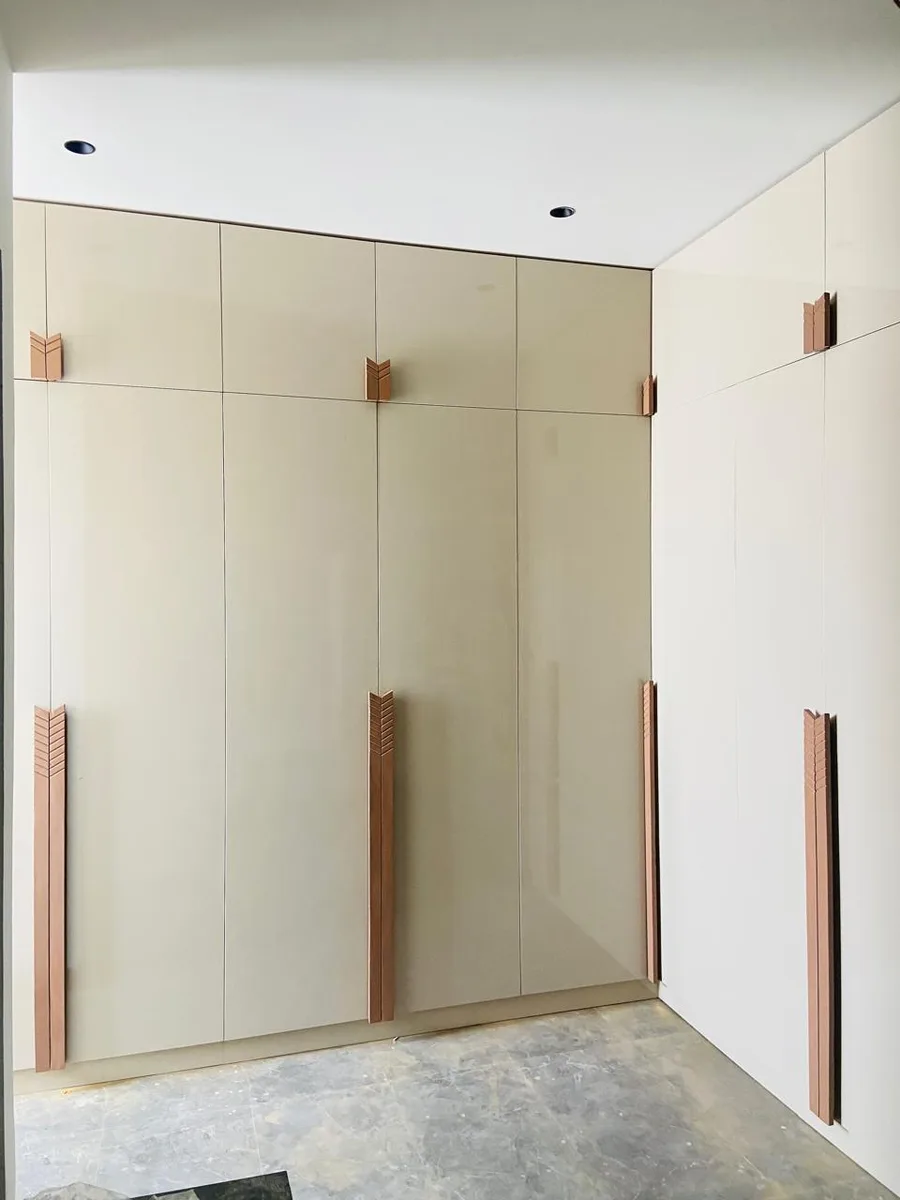
Indoor air: the board matters more than the paint
The standard advice is to ask for low-VOC paint. It is correct and it is the smaller half of the problem.
A finished apartment interior contains far more square footage of engineered board than of painted wall, and board is held together with formaldehyde-based adhesive that off-gasses for months to years after installation. Which adhesive depends on the grade — and this is the useful part, because it maps exactly onto a decision you were already making for water resistance.
Commercial and MR-grade plywood is typically bonded with urea-formaldehyde. BWP marine grade to IS 710 is bonded with phenol-formaldehyde, which is a more stable, more cross-linked resin: it is what makes the board survive 72 hours in boiling water, and it also off-gasses considerably less formaldehyde than urea-formaldehyde does. The grade decision we argue for on durability grounds in BWP vs BWR vs MDF happens to be the better indoor-air decision too.
Raw MDF and particle board are the worst offenders per square foot, both because of the resin fraction and because of the sheer surface area of exposed fibre. If MDF is used as a shutter substrate under a gloss or PU finish — which is legitimate, and is where we do use it — the finish itself seals most of that surface, and the cut edges are what to insist are sealed too.
What to actually ask for, in writing: the board's formaldehyde emission class, stated per line. E1 is the widely used low-emission threshold and E0 lower still; a supplier who cannot tell you the class of the board they are quoting is not selling you a specified product. Then ventilate hard for the first several weeks after handover — cross-ventilation for a few hours daily does more for indoor air in a new flat than any single material substitution.
Low-VOC paints and finishes, ranked by how much they matter
Paints and finishes are the fast-release half: high emission for days to weeks, then a sharp drop. That is why the fit-out sequence matters as much as the product.
In descending order of VOC contribution in a typical Indian fit-out:
- Sprayed PU and solvent-based finishes. The heaviest single source. PU is sprayed as a solvent-carried coating in a booth, and where that spraying happens is the question worth asking — factory-sprayed shutters cured off site arrive having released most of their solvent elsewhere, while on-site spraying puts it in your home. Water-based PU systems exist, cost more, and are the substitution with the largest real effect.
- Adhesives. Contact adhesive for laminate is applied across every square foot of every laminated surface in the flat, and solvent-based versions are pungent for a reason. Water-based and low-VOC contact adhesives are available and are rarely specified because nobody asks.
- Solvent-based enamels on grilles, doors and metalwork.
- Wall emulsion. The thing everybody asks about, and genuinely the least of these. Water-based acrylic emulsions are already low-VOC by construction, and most major Indian brands sell explicitly low- or zero-VOC lines at a modest premium.
The ordering has a practical consequence: specifying a premium zero-VOC emulsion while accepting on-site solvent PU spraying and solvent contact adhesive is spending money on the smallest term in the equation.
Longevity is the sustainability nobody sells
An interior that is demolished and rebuilt after four years has roughly double the material footprint of one that lasts eight, and no choice of surface finish comes close to compensating for that.
This is where the specification arguments on this site turn out to be environmental arguments. MDF used as a kitchen carcass in a wet zone can be expected to fail in two to four years; a single overnight leak destroys it irreversibly. Hardware is the other early failure: a cheap hinge that fails its cycle life takes the shutter's alignment with it. Getting either wrong means the box or the run is rebuilt long before the rest of the interior is tired.
The most sustainable line in a quotation is usually the one specifying the correct grade for the zone, and the second is named, cycle-rated hardware. Both are unglamorous and neither photographs.
Operating energy: the decisions that outlive the fit-out
Interiors set the lighting and cooling load semi-permanently, because changing it later means opening ceilings.
- Circuit design over fitting count. Layered lighting on separate switched circuits — ambient, task, accent — means a room can be lit at 20% of its maximum draw for most of the evening. A single bright ceiling circuit is either fully on or off, and gets left fully on.
- Light where the work happens. Under-cabinet task lighting in a kitchen replaces a much larger ceiling load, and the same is true of a desk and a reading position.
- False ceiling depth against cooling. Dropping a ceiling reduces the room volume being cooled, which cuts the load — but it also traps heat above the plasterboard if the slab faces afternoon sun, so it is a real trade-off rather than a free win.
- Fabric before machinery. On a west-facing wall, a heavy curtain track detailed into the ceiling and a shading solution do more for a summer bill than upgrading the air conditioner, and both are interior-scope decisions.
So are sustainable interiors more expensive?
Partly, and not in the places people expect. We publish no percentage for this, because a premium depends entirely on which of the substitutions you make and there is no honest single number for it — but the direction of each one is clear.
Genuinely costs more: water-based PU in place of solvent PU; low- and zero-VOC emulsion lines over standard ones; low-VOC contact adhesive; certified low-emission board over uncertified board of the same grade; and named cycle-rated hardware over unbranded.
Costs nothing: specifying phenol-bonded BWP where the zone needs it anyway, since you should be buying it for water resistance regardless; sealing cut edges; sequencing spray work off site; separating lighting circuits at drawing stage rather than after; ventilating aggressively after handover; and asking for the emission class in writing.
Saves money: not rebuilding. Correct grade per zone and hardware that survives its cycle life are the two decisions that keep an interior out of a skip, and they pay back in both currencies.
The honest summary is that the sustainable version of a fit-out done properly is not a different fit-out. It is the same specification discipline, extended to finish chemistry and pushed slightly harder on the two or three line items where the premium buys something measurable.
Written by Gogineni Kalyaan Kumar
Kalyaan is Principal at AlcorOne Solutions, the interior contracting firm he co-founded in 2022. He has overseen 80+ turnkey residential, villa, and commercial fit-outs across Chennai, Hyderabad, Bengaluru and Vizag, with a focus on itemised BOQs, heavy-duty modular execution, and durable interior systems built for South India’s climate.
Sources & references.
Standards, regulatory registries, and manufacturer references that back the material grades, pricing framework, and compliance points in this guide:
Frequently asked questions.
Are sustainable interiors more expensive?
Some parts, and less than people assume. Real premiums sit on water-based PU instead of solvent PU, low- or zero-VOC emulsion and contact adhesive, certified low-emission board, and named cycle-rated hardware. Several of the highest-value choices cost nothing at all: specifying phenol-bonded BWP where the zone needs it anyway, sealing cut edges, having spray finishing done off site, separating lighting circuits at drawing stage, and ventilating hard after handover. And the largest environmental variable — not demolishing and rebuilding the interior in four years — saves money outright. We do not publish a percentage premium, because it depends entirely on which substitutions you make and any single figure would be invented.
Which low-VOC paints should I use, and does it matter much?
Water-based acrylic emulsions are already low-VOC, and most major Indian brands sell explicit low- or zero-VOC lines at a modest premium. But wall emulsion is the smallest VOC source in a typical fit-out. The largest is sprayed solvent-based PU, followed by solvent contact adhesive used under every laminated surface in the flat, then solvent enamels on metalwork. Specifying a premium zero-VOC emulsion while accepting on-site solvent PU spraying is spending on the smallest term. Ask for water-based PU, low-VOC adhesive, and for spray work to be done off site.
What actually makes an interior sustainable?
Three measurable things. Indoor air quality, which is decided by board adhesive chemistry and finish chemistry. Longevity, which is decided by specifying the right grade per zone and hardware that survives its cycle life — an interior rebuilt after four years has roughly twice the material footprint of one that lasts eight. And operating energy, set by lighting circuit design and cooling decisions that are hard to change once ceilings close. Cane, jute and reclaimed timber are aesthetic choices and do not address any of the three.
Do plywood and MDF off-gas formaldehyde?
Yes, for months to years after installation, and there is more board than painted wall in a finished flat. The grade determines how much: commercial and MR plywood are typically bonded with urea-formaldehyde, while BWP marine grade to IS 710 uses phenol-formaldehyde, which is more stable and off-gasses considerably less. Raw MDF and particle board are the highest emitters per square foot. Ask for the board's formaldehyde emission class per line in the BOQ — E1 is the common low-emission threshold, E0 lower — and insist that cut edges are sealed.
Does AlcorOne offer a green or sustainable package?
No, and we would be suspicious of one. There is no separate sustainable product line here; there are line items in a BOQ. What we will do is name the board grade and emission class, the finish system and whether it is water-based, the adhesive, and the hardware, per line, so the choices are visible and you can decide where a premium is worth paying. A "green package" that does not itemise those things is a label.
Is a false ceiling good or bad for energy use?
Both, depending on the slab above it. Dropping the ceiling reduces the volume of air being cooled, which lowers the load. But it also traps heat between the plasterboard and a slab that has been in afternoon sun, which can work against you. It is a genuine trade-off to be decided per room and orientation, not a blanket efficiency measure.
If indoor air quality matters to you, the place to act is the BOQ, not the showroom: board grade and emission class, whether the PU is water-based, which adhesive is used, and where spraying happens. Ask for all four in writing before signing. Anything not named in the document is not specified, whatever was said in the meeting.
Ask for the grade and the finish in the BOQ.
Indoor air quality is decided by board adhesive and finish chemistry, both of which are BOQ line items. If they are not named in writing, you are not specifying them.
Get a callback + itemised BOQ
Leave your name and number — we'll call you back with a scope and a ballpark BOQ for your Hyderabad project. No obligation.