The Render Won't Save You
You walk in with a Pinterest board, a vague dream, and no way to describe what you actually want. That used to mean weeks of back-and-forth. Now a firm can show you three versions of your living room before you have finished your chai. That is real, and it is genuinely useful. It also means a photorealistic picture of a finished room is now free to produce — which makes it worth almost nothing as proof of anything.
The render is not the room
Start here, because everything else follows from it.
A generated image is a picture of an intention. It is not a specification, not a drawing, and not a promise. It does not know whether that wall is load-bearing. It does not know that the marble in it is not in your budget and is not available this quarter. It does not know that the joint it drew has never been built by anyone within thirty kilometres of your flat.
AI is a microphone, not a voice. It amplifies whatever it is fed. Feed it a vague brief and it returns a confident, beautiful, unbuildable answer — and it returns it fast enough that nobody stops to check.
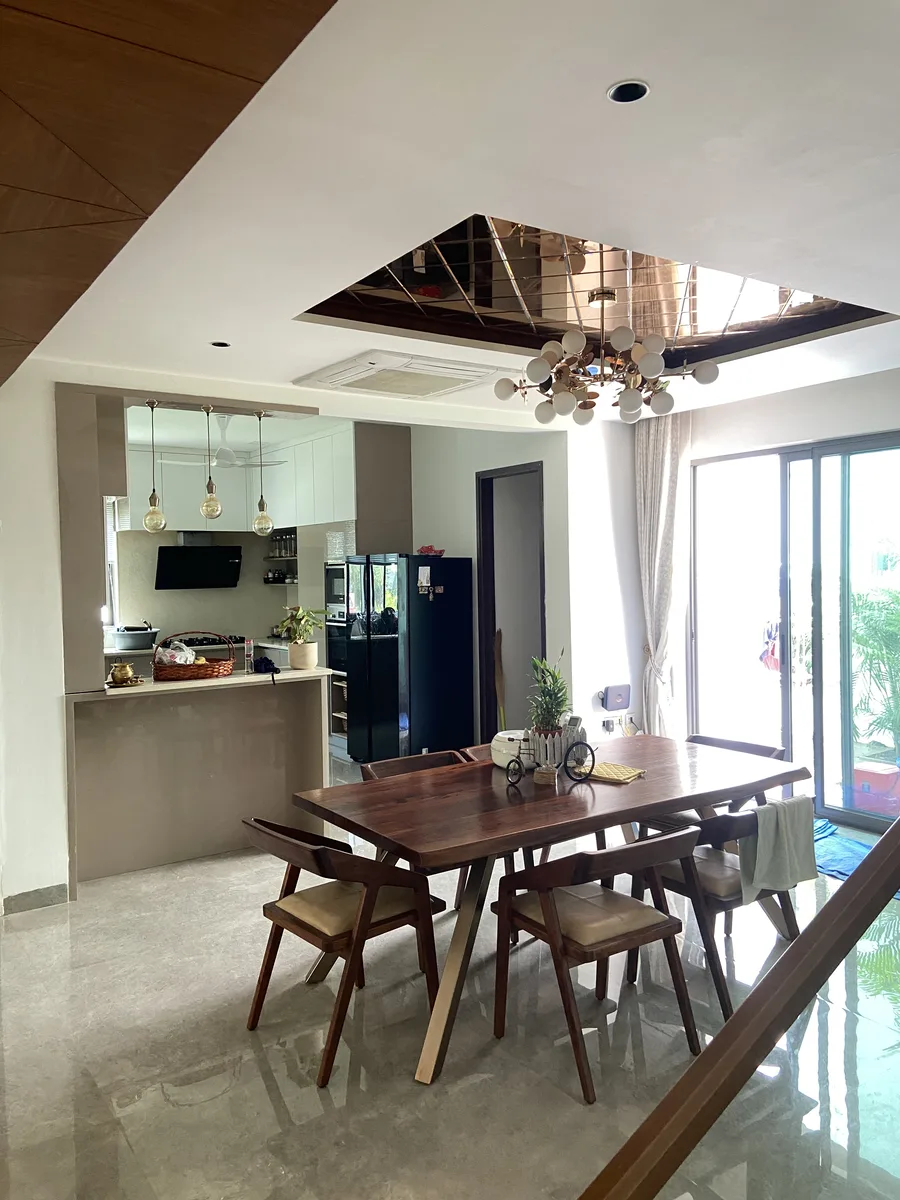
What genuinely got better, and it is on your side
Two real changes, both of which favour you rather than us.
Showing you options has become almost free. Concept imagery that needed a paid 3D artist and several days now takes minutes. So if a firm is charging you a substantial separate fee to show you what a room might look like, that fee is much harder to justify than it was three years ago. Insist visualisation is its own line in the quotation. It is one of the very few line items whose fair price has actually fallen.
You arrive better informed. Clients now turn up knowing what BWP means, that hardware is a brand and a model rather than an adjective, and that a Bill of Quantities is a document they are entitled to see. That is unambiguously good, and it is hardest on the firms that were relying on you not knowing what to ask.
The bottleneck was never creativity. It was trust.
Firms here do not fail because nobody can design. The imagination gap was real — you say "modern Indian" or "Japandi" and cannot articulate what you mean — and AI has largely closed it. Upload a photo, see three directions, choose one, move on.
Then the actual work starts. Dimensioned drawings. Services coordination. Material specification. Vendor negotiation. Somebody standing on site when the plumber is late and the tiles turn up from the wrong batch.
What you were ever really buying was trust: that what you saw is what you get, that the quote will not quietly double, that someone is managing the distance between the picture and the room. None of that has been automated. Not a single part of it.
What AI cannot know about your project
Not "cannot do yet". Cannot know, because the information does not exist in any model.
- Your actual walls. They are out of square, the slab varies, and the builder's handover drawing does not match the flat. Every honest number in a quotation traces back to somebody physically measuring.
- Which of two contractors does better tile work, and what each charges. That knowledge lives in people who have inspected finished work, and it is most of what a good contractor is actually selling you.
- That you changed your mind about the air conditioning after the false ceiling went up. Real projects are a sequence of decisions, some of them reversed, and the cost of a reversal depends entirely on when it happens.
- Your building's rules. Society approvals, service shaft access, working hours, when the lift can be used for material. None of it is in the render and all of it is in your timeline.
- Vastu, and your family. An image will happily generate a beautiful pooja unit facing the wrong way. It does not know who in the household holds a veto.
It also cannot stand on site at six in the evening and make a judgement call about a level difference, chase a vendor who is three days late, or be accountable when a carcass fails in year three. No generated image carries a warranty.
The thing that actually changed for you: a portfolio has stopped being evidence
This is the part worth acting on today.
Until recently, a photorealistic picture of a finished Indian apartment was reasonable evidence that somebody had built one, because faking it convincingly took a skilled artist and real effort. That is no longer true at any price.
So say it plainly: a portfolio of beautiful images now proves nothing about whether a firm can execute. It may not prove the firm exists in the form it claims. This is the older warning about "designers" who are really 3D artists outsourcing the building — except the barrier to becoming one has fallen to zero.
We are not exempt from this, which is why we label our own. The concept visuals in our catalogue pages say on the page that they are AI-generated concept visuals rather than photographs of completed work, because a catalogue of generated options is genuinely useful for choosing between formats and becomes a lie the moment you assume those are rooms we built. Every photograph of completed work on this site is a photograph of completed work.
Four questions that still work
- "Is this specific image a photograph of work you completed?" Ask about particular images, and ask over email so the answer is in writing. It takes one line to answer. Evasion is the answer.
- "Can I visit it?" The one test that has not weakened at all. Nothing generated survives it.
- "What is the BOQ behind this image?" A built project has a Bill of Quantities, board grades by zone, named hardware. A generated image has no specification behind it — not a hidden one, none. Ask what the carcass grade and the hinge model in that photograph were.
- Ask for the boring evidence. Dated progress photographs from during the build, snag lists, handover documents, a client who will take your call. Nobody generates pictures of a dusty half-finished site, because there is no marketing value in it. Which is exactly what makes it credible.
What to demand instead of prettier pictures
The firm-side version of this advice is about building systems. Your version is about insisting those systems exist before you sign.
- Ask what is in their library, not their gallery. Standard details that have been built before, a material list with real rates and lead times, previous BOQs. A firm working from its own accumulated project data gives you a different answer from one improvising each time — ask which you are getting.
- Bring the mess, expect a document back. Send the voice note, the three reference images, the crumpled floor plan. What should come back is a structured brief and then a priced BOQ. If chaos in produces chaos out, you have learned something early and cheaply.
- Insist generated imagery is labelled as conceptual. In writing. A direction, not a contract.
- Make the drawings the source of truth. The image suggests; the dimensioned drawing and the BOQ decide. Where they disagree, the drawing wins, and that should be stated before work starts.
- Demand freezes. Concept approval, layout freeze, material freeze, BOQ sign-off, drawings issued. No step skipped because a render looked convincing. Every one of those is a point where a change is still cheap.
- Ask how you will see progress. Dated photographs, milestone comparison, a snag list you did not have to drive across town at eight in the evening to compile. If nobody can tell you how you will know what is happening, you will not know.
The best arrangement is not AI-only, and it is not AI-free
The human owns the brief, the buildability, the budget and the accountability. The tool owns the speed, the options and the drudgery. A firm using neither is slow. A firm using only the tool is confident and wrong.
So do not judge a firm on whether it uses AI. Judge it on whether it can tell you who measured, who supervises, what the BOQ names per zone, and what the warranty covers. Those questions have not changed at all, and they are still the only reliable signal you have.
The hard truth
Generated renders are becoming ordinary. Everybody will have them, they will be fast and cheap, and they will be everywhere. They will stop being a differentiator for the firm and stop being information for you.
What stays hard to copy is unglamorous: verified material libraries, real supplier rates, standard details that survive Indian conditions, and delivery that builds a reputation. That is the part nobody can generate.
The render won't save you. The system behind it might — so ask about the system.
Written by Pradeep Kumar Vasadi
Pradeep Kumar Vasadi is a co-founder and Principal at AlcorOne Solutions. He grew up in Rajamahendravaram and spent years on the factory floors of Chennai’s manufacturing setups — hard, hands-on work that lit his drive to build something of his own. He now leads project delivery, on-site supervision, and vendor coordination, holding AlcorOne’s fit-outs to shop-floor standards of precision across South India.
Sources & references.
Standards, regulatory registries, and manufacturer references that back the material grades, pricing framework, and compliance points in this guide:
Frequently asked questions.
How is AI changing interior design in India?
Mostly at the front of the process, and mostly in your favour. Showing you concept options has become fast and nearly free, which means a large separate visualisation fee is much harder to justify than it was — insist it is its own line in the quotation. Buyer research has also improved sharply, so clients arrive knowing what BWP means and that a BOQ is a document they can ask for. What has not changed is anything after the drawing: site measurement, fabrication tolerance, trade sequencing and warranty accountability are untouched, and that is where nearly all the risk in a project actually sits.
How can I tell whether an interior firm's portfolio images are real?
Four questions. Is this specific image a photograph of work you completed — asked about particular images, over email, so the answer is in writing. Can I visit it, which is the test nothing generated survives. What is the BOQ behind this image, including the carcass grade and the hinge model, because a built project has a specification and a generated image has none at all. And ask for the boring evidence: dated progress photographs from during the build, snag lists, handover documents, a contactable client. Nobody bothers to generate pictures of a dusty half-finished site, which is precisely why they are credible.
Does AlcorOne use AI-generated images?
Yes, for concept visuals in our catalogue pages, and those pages state on the page that the images are AI-generated concept visuals rather than photographs of completed work. They exist to show format, proportion and material direction across many options quickly. We do not generate an image of a project and present it as delivered work — every photograph of completed work on this site is a photograph of completed work.
Can AI design my home interior?
It can produce options for you to react to, which genuinely helps early on, and it cannot produce a buildable project. It has not measured your flat, and your builder's drawing does not match your walls. It does not decide board grade by zone, hold a millimetre tolerance across a handle-less run, sequence wet trades against carpentry, know your society's rules, or carry a warranty when something fails. Use generated imagery to shorten the conversation about what you want. Do not mistake it for drawings, a BOQ and somebody accountable.
Should I still pay for 3D renders?
Yes, but as a separate and now smaller line. Their real job is agreeing the look before anything is built, so that disagreement happens on a screen rather than on site where it becomes a variation. That is worth real money on unusual joinery and much less on a conventional flat. What has changed is the cost of making them, so a large bundled visualisation fee is harder to defend than it used to be. And never treat a render as evidence of delivered quality — its material accuracy is a rendering setting, not a specification.
Is "AI-powered interior design" a meaningful claim?
As a description of a sales process, sometimes. As a description of delivery, no. It refers to concepts and imagery, while the risk in an interior project is concentrated in measurement, sequencing, tolerance and who is liable when something fails. A firm leading with the phrase is telling you about its marketing. Ask instead who measures, who supervises, what the BOQ names per zone, and what the warranty covers.
If an image is what convinced you about any firm, including this one, ask whether it is a photograph and ask to visit the project. We label our concept visuals as generated on the pages where they appear, and our completed-work photographs are photographs. Both of those are one-line questions, and how a firm handles them will tell you more than the pictures ever will.
Ask whether the image is a photograph.
It is a fair question. It takes one line to answer. A firm that will not answer it in writing has just answered it.
Get a callback + itemised BOQ
Leave your name and number — we'll call you back with a scope and a ballpark BOQ for your Hyderabad project. No obligation.